

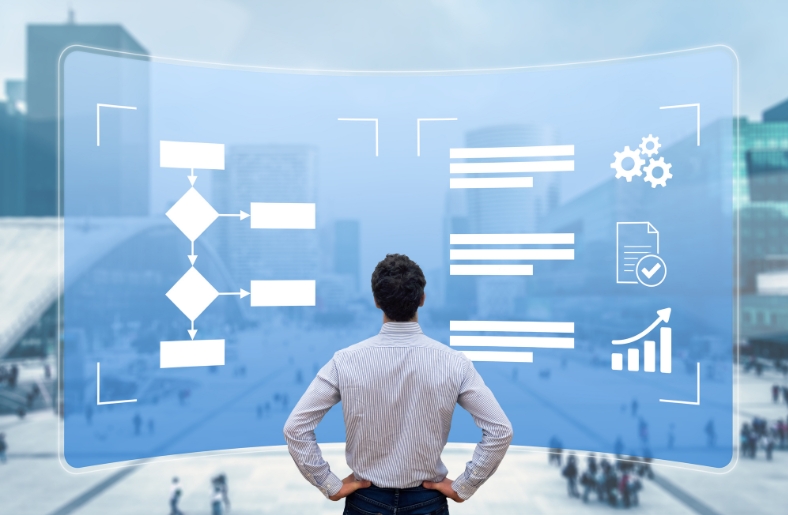
Artificial intelligence is leaving chat interfaces and single-step automation. A new execution model is emerging across modern software systems known as AI workflow agents. Such systems are set to accomplish structured multi-step tasks with reasoning, planning, and controlled autonomy.
For technology teams, platform evaluators, and AI infrastructure readers, AI workflow agents represent a meaningful architectural shift. They fall in between the extremes of automating processes by rules and having totally autonomous agents and allow intelligent execution within the scope of predetermined workflows.
This guide explains what AI workflow agents are, how they function at a systems level, where they fit inside modern tech stacks, and how platforms such as Beam.ai apply workflow-driven agent execution in practice.
What AI Workflow Agents Actually Are
AI workflow agents are structured AI-powered execution units that carry out multi-stage processes aligned to a defined objective. Contrary to prompt-based interactions with AI, these agents are found within a guided workflow model that influences the reasoning and output format.
Practically, an AI workflow agent gets a goal and generates a limited series of reasoning steps to produce a specified deliverable. The deliverable could be organized analysis, a plan document, a result of classification, or a technical overview.
It is quite similar to the work of agent-based AIs, where systems are designed to plan and take action as opposed to merely respond. This process of development of agent-oriented reasoning systems is recorded in the Stanford Human Centered AI research archive.
It is defined by organized smart performance, rather than random word generation.
Why Traditional Automation Models Are Hitting Practical Limits
Rule-driven engines of automation are effective in cases where workflow is predictable and the input remains steady. When there are interpretations, conditional reasoning, or adaptive sequencing of work flows, they will become brittle.
The conventional automation relies on pre-set branches. All the routes should be pre-mapped. The workflow can fail or must be manually redesigned when there are changes in the inputs or ambiguity.
There are numerous technical processes in the modern world that require interpretation. Some examples are research synthesis, requirement scoping, opportunity analysis, and structured planning. No, these are not routing problems. They are reasoning problems.
Intelligent systems research at MIT, Slogan points out that AI provides the most operational value when used in decision-intensive processes as opposed to repetitive triggers.
AI workflow agents are specifically designed for this reasoning and structure layer.
Core Technical Components of AI Workflow Agents
Objective Definition Layer
Every workflow agent has an outcome that is clearly spelled out. The reason is the explicit and limited goal. This is a borderline that is vital to reliability and testability.
Objective framing enhances the quality of execution explicitly.
Rationality and Strategy Engine
The reasoning level examines the inputs, chooses to carry out intermediate steps, and decides in what order to execute within the workflow constraints. This layer is usually supported by large language models and hybrid reasoning models.
It is here that matching simple rules are substituted with interpretation.
Modular Skill or Tool Layer
The contemporary agent platforms tend to deploy modular skills within the workflows. Such modules have a narrower role, i.e., analysis, summarization, extraction, or structured generation.
Beam.ai is based on this model of a skill-based workflow. Users do not make open prompts, instead performing specified agent skills based on particular types of output. Glancing over Beam.ai skill workflow pages, one will find the objective of the execution and an expected artifact, proving more informative than feature lists to judge agent systems.
Structured Output Layer
The workflow agents typically generate non-freeform text streams but structured ones. This simplifies validation of results, reuse,, and their integration into downstream systems.
Where AI Workflow Agents Fit in Modern Tech Stacks
AI workflow agents function best as an intelligence execution layer above raw data systems and below final human decision authority.
They are particularly useful at workflows that involve synthesis and organization, such as technical research overviews, scope requirement descriptions, landscape documentation, and multi-source insight summarization.
When it comes to deterministic pipelines or transactional systems, they are no substitutes. Instead, they improve work processes where interpretation and format have to co-exist.
According to the coverage of AI research by Gartner, these systems are commonly placed in the intelligent automation and agent-assisted execution categories, which fits this classification.
Beam.ai as a Practical Workflow Agent Implementation
Beam.ai is an example of the practical design of AI workflow agents based on skill-centered execution flows. The platform focuses on the organized workflows as opposed to repetitive prompt engineering.
Every agent process is linked to a determined execution product like formal analysis or planning deliverable. It is a better method of achieving repeatability and decreasing variance than free-form prompting.
Technically speaking, the first step of workflow definition followed by model generation is a good sign of reliability. That trend is being established as a best practice in applied agent design.
In evaluating workflow agent platforms, it is better to review workflow-specific pages rather than read high-level product summaries since workflow descriptions reveal scope, constraints, and structure of workflow output. Beam AI The skill pages of AI offer a level of operational detail.
Advantages of Workflow Constrained Agents Engineering
Agents that are workflow constrained have some useful engineering advantages. Considering that results are in standard formats, they are easily tested. The execution paths are bounded, and hence monitoring them is easier. They are less troublesome to believe since it is scope controlled.
This constraint enhances operational usability as opposed to constrained capability.
The guidance on applying AI architecture provided by Google Cloud supports the significance of limited AI elements within the production processes.
This design principle is in great favor of agent models that have workflow constraints.
Common Misunderstandings About AI Workflow Agents
They only have new branding chat interfaces
This is inaccurate. Interaction layers are chat systems. Execution layers are called workflow agents. The architectural position is dissimilar.
They are complete AI autonomous systems
Workflow agents are functioning within certain limits of execution. Fully autonomous agents are more exposed to risk and are more autonomous.
They can only be applied in the marketing situations
One of the visible applications is marketing, but the workflow agent model is domain neutral. It is applicable in technical, operational, analytical, and planning processes.
AI adoption studies across industries through research at McKinsey reveal identical patterns of agent style execution that emerge across various industries.
Technical Team Implementation Guidance
AI workflow agents are most effective where workflows are already understood but execution is slow and reasoning intensive. Clarity of goals and specifications of output enhance reliability.
High-impact outputs should have human validation involved in the process. The workflow agents are expected to be considered as execution accelerators and structured reasoning partners.
The metrics of success must be on time compression, quality of output structure, and usefulness of decision support.
Final Technical Assessment
AI workflow agents represent a practical and necessary evolution in intelligent software execution. They also bring reasoning to work processes and maintain structural control and repeatability.
The workflow-constrained agent execution will probably become the common architectural layer between the automation engines and human decision-makers as AI infrastructure matures. The Beam.ai platform is an example of how AI reasoning can be transformed by skill-based workflow agents into limited and reusable execution outputs. For technology professionals tracking the shift from AI interaction to AI execution, AI workflow agents are a category that deserves close attention.
FAQs:
What are AI workflow agents?
AI workflow agents are structured AI systems that execute multi-step tasks toward a defined goal using reasoning and workflow constraints. They focus on intelligent execution, not just prompt responses.
How are AI workflow agents different from automation tools?
Traditional automation follows fixed rules. AI workflow agents use guided reasoning within workflows, allowing them to interpret inputs and produce structured outputs across multiple steps.
Are AI workflow agents the same as autonomous AI agents?
No. Workflow agents operate within defined boundaries and objectives. Autonomous agents act with broader independence and fewer controls.
Do AI workflow agents require coding?
Most modern platforms provide predefined workflow skills and guided interfaces, so coding is not required for standard use cases.
Where does Beam.ai fit in AI workflow agents?
Beam.ai is a workflow agent platform that provides skill-based, structured agent workflows for research, planning, and execution tasks instead of open prompt-driven generation.