

Databricks’ valuation hit $134 billion in December 2025. Annual recurring revenue reached $5.4 billion. Customer count crossed 20,000, including the NBA, AT&T, Shell, and major US government agencies. The H2 2026 Databricks IPO is one of the most anticipated in tech.
But hype and what is right for you are different things. This Databricks review 2026 answers what matters: should your organization actually deploy Databricks, or is the lakehouse architecture overkill for your use case?
Databricks is the strongest end-to-end data and AI platform on the market. But Databricks pricing is complex, the learning curve is real, and for SQL-only analytics teams, Snowflake Cortex AI delivers 80% of the value with far less operational overhead.
Quick Verdict
| Score: 9.0 / 10 | Best for mid-large enterprises with heavy data engineering, multi-source data integration, complex ML pipelines, and the technical capacity to run a lakehouse. Real year-1 cost: $50,000 to $5,000,000+ depending on workloads, plus underlying cloud compute typically 40-60% of Databricks spend. Skip if you have SQL-only analytics, no data engineering expertise, or data that lives entirely in one warehouse. |
What Is Databricks?
Databricks is the original lakehouse architecture platform. The lakehouse combines data lake economics (cheap storage, open formats) with data warehouse capabilities (SQL, ACID transactions, governance) on one unified foundation. The platform spans the Lakehouse Platform (data engineering, ETL, Delta Lake, Unity Catalog governance), Mosaic AI (agent framework, model serving, MLflow), Databricks SQL (cloud analytics), AI/BI (native intelligence), and Apps (custom data applications).
Customer adoption is substantial. From the December 2025 funding disclosure: 20,000+ customers, including 60% of the Fortune 500, $5.4B ARR (up from $3B in early 2025), and 80%+ growth on AI workloads year over year. The 2025 MosaicML acquisition added foundation model training and serving capabilities.
Databricks Pricing in 2026: The Two-Bill Reality
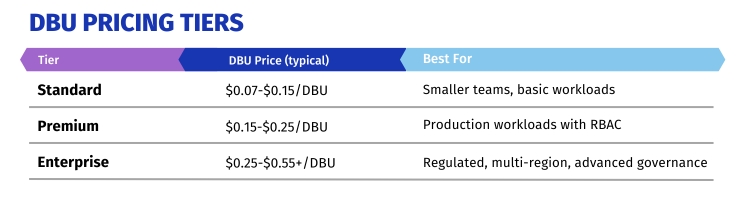
This Databricks review 2026 covers Databricks pricing honestly: it uses Databricks units (DBUs) based on consumption. One DBU represents one hour of compute on a specific instance type. Pricing varies by cloud provider, region, instance type, and workload tier.
The Two-Bill Reality
Databricks pricing involves two separate bills. Databricks charges DBUs. Your cloud provider charges underlying compute (VMs, storage, networking). Most enterprises see roughly 40 to 60% of total spend on Databricks DBUs and 40 to 60% on cloud provider compute and storage. This dual-bill model is the most-cited procurement frustration in customer reviews.
Hidden Cost Traps
Beyond Databricks pricing at the DBU level, four cost traps consistently surprise first-time buyers:
- All-Purpose Clusters left running: Engineers leave clusters running, racking up DBU charges. Auto-termination is not optional.
- Photon engine premium: Photon costs more per DBU but often runs faster, so net cost can be lower if used correctly. Requires careful workload matching.
- Multi-region replication: Cross-region data replication adds significant cloud storage and egress costs outside the DBU bill.
- Unity Catalog learning curve: Misconfigured Unity Catalog creates data access issues that delay projects. The real cost is lost engineering time.
What This Databricks Review 2026 Finds Genuinely Good
1. End-to-End Data + AI on One Platform
Databricks is the only platform that genuinely handles the full data and AI lifecycle on one foundation: data ingestion, ETL, warehousing, ML training, model serving, AI agents, and BI dashboards, all on shared Unity Catalog governance. For data-engineering-led organizations, this consolidation is real. Most enterprises running fragmented stacks (Fivetran, Snowflake, dbt, MLflow, and SageMaker) evaluate Databricks within 2 to 3 years.
2. Mosaic AI Agent Framework
The Mosaic AI Agent Framework is the 2026 standout feature. Built on the MosaicML acquisition, it delivers production-grade AI agent development on top of governed enterprise data:
- Multi-agent orchestration with governed tool access via Unity Catalog
- RAG (retrieval-augmented generation) grounded in Unity Catalog data
- Model fine-tuning on enterprise-specific data
- Model serving with autoscaling and full observability
- Evaluation and red-teaming tooling for production AI agents
For enterprises building AI agents that need governed corporate data access, Mosaic AI Agent Framework is among the strongest platforms in 2026.
3. Unity Catalog: The Governance Foundation
Unity Catalog provides unified governance across structured data, unstructured files, ML models, and AI assets. RBAC, lineage tracking, audit logs, and data discovery all flow through one layer. This matters more in 2026 than in any prior year as the EU AI Act and US state-level AI regulations create real audit requirements that Unity Catalog is architecturally positioned to meet.
4. Open Formats
Databricks champions open formats: Delta Lake (donated to the Linux Foundation), Apache Iceberg compatibility, and MLflow (open source). This means enterprises can exit if needed, which is rare in cloud data platform contracts. The open-format commitment changes the lock-in calculus meaningfully.
5. Performance at Petabyte Scale
For genuinely large workloads (petabyte-scale data, hundreds of concurrent users, and complex multi-stage pipelines), Databricks performance is hard to match. Photon and the underlying Spark engine handle scale that breaks most other platforms.
Where Databricks Falls Short
- Pricing complexity. Forecasting Databricks spend requires understanding DBUs, instance types, workload tiers, cloud provider pricing, region multipliers, and Photon premiums. Even seasoned data engineering teams struggle with cost predictability.
- UI sluggishness. Heavy notebook usage causes UI lag. Search and navigation feel slower than modern alternatives like Hex or Mode. For teams where data scientists live in notebooks, this matters daily.
- Learning curve. Cluster configuration, Spark tuning, Unity Catalog setup, MLflow workflows. Each requires substantial depth. New team members typically need 4 to 6 weeks before independent productivity.
- Documentation gaps. For advanced capabilities, documentation often trails feature releases. Engineers frequently end up filing support tickets or experimenting through configuration options.
- The Snowflake comparison. For SQL-only analytics teams, Snowflake is genuinely simpler. If data is already in Snowflake and workloads are dashboards plus light ML, Snowflake Cortex AI delivers 80% of the value with far less operational complexity.
Databricks vs. Alternatives in 2026
The Databricks vs. Snowflake decision drives most data platform evaluations. This Databricks review addresses it alongside the full alternative set:
| Factor | Databricks | Snowflake | MS Fabric | AWS SageMaker |
| Pricing model | DBU + cloud compute | Credits + storage | Capacity Units | Per-resource |
| Data engineering | Best in class | Limited (improving) | Good | Decent |
| ML/AI maturity | Excellent (Mosaic) | Good (Cortex) | Good | Excellent (separate) |
| SQL analytics | Strong | Best in class | Strong | Limited |
| Governance | Unity Catalog (excellent) | Native (excellent) | Microsoft Purview | AWS Lake Formation |
| Open formats | Yes (champions) | Limited | Yes (Iceberg) | Mixed |
| Best for | Multi-cloud data engineering | Snowflake-centric SQL | Microsoft-aligned | AWS-native ML |
On Databricks vs. Snowflake: they solve different jobs. Databricks vs. Snowflake is not a “versus” question for most large enterprises. Databricks wins for end-to-end ML pipelines and complex data engineering across multiple clouds. Snowflake wins for SQL-native analytics and data sharing on Snowflake-centric data. Many enterprises run both. The 2026 NVIDIA partnership has strengthened Snowflake’s AI capabilities, narrowing the gap on lighter ML use cases.
Who Should Buy Databricks in 2026?
Buy if: Heavy data engineering needs (multiple sources, complex ETL, streaming). The team has Spark and Python expertise. Building production AI/ML pipelines, not just SQL analytics. Multi-cloud operation now or anticipated within 2 to 3 years. Open formats and avoiding lock-in are strategic priorities. Building agentic AI on enterprise data (Mosaic AI Agent Framework wins here).
Skip if: SQL analytics only (Snowflake wins on simplicity). No data engineering team and cannot hire one. Data lives in one place without growing complexity. Microsoft-aligned (Fabric is the native answer). Want predictable, simple pricing (DBU complexity will frustrate procurement).
Final Verdict: Databricks in 2026
Databricks is the most capable end-to-end data and AI platform on the market. The lakehouse architecture, Mosaic AI Agent Framework, Unity Catalog governance, and open-format leadership add up to a platform that solves the hardest enterprise data challenges. Among today’s leading enterprise AI platforms, Databricks continues to set the benchmark for unified data and AI workloads.
For enterprises with heavy data engineering, complex ML pipelines, and multi-cloud strategies, this Databricks review 2026 verdict is clear: it is the right answer. The H2 2026 IPO will validate this with public market pricing.
For SQL-only analytics teams, Snowflake or Microsoft Fabric delivers 80% of the value at far less operational complexity. For Microsoft-aligned enterprises, Fabric is the native choice. For AWS-native ML-first teams, SageMaker plus Bedrock is often the better answer than Databricks plus Mosaic.
The platform that wins is the one that runs next to your data and matches your team’s skills. For data-engineering-led organizations, that is Databricks.
Score: 9.0 / 10 | Buy if you have data engineering expertise and complex multi-cloud needs. Skip if you want SQL-only simplicity.
FAQs:
Databricks review 2026: Is it worth the valuation hype?
Yes, for data-engineering-heavy organizations. The Databricks IPO in H2 2026 will validate this with public market pricing. Whether the platform is worth it for your organization depends entirely on use case depth. For SQL-only teams, the answer is almost certainly no.
How much does Databricks cost in 2026?
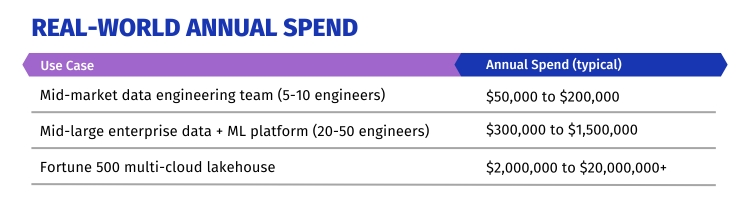
Databricks pricing is consumption-based via DBUs. Mid-market data engineering teams typically spend $50,000 to $200,000 per year. Mid-large enterprises spend $300,000 to $1.5 million. Fortune 500 multi-cloud deployments can exceed $20 million annually. Cloud provider compute (40 to 60% of total) is billed separately by your cloud provider.
Databricks vs. Snowflake: Which wins in 2026?
Databricks vs. Snowflake: different jobs. Databricks wins for end-to-end data engineering plus ML and AI on multi-source data. Snowflake wins for SQL-native analytics on Snowflake-centric data. Many enterprises run both simultaneously. The right choice depends on whether your primary workloads are ML pipelines or SQL analytics.
What is the Mosaic AI Agent Framework?
Mosaic AI Agent Framework is Databricks’ production AI agent development platform, built on the 2025 MosaicML acquisition. It enables multi-agent orchestration, RAG with governed Unity Catalog data, fine-tuning, model serving, and evaluation tooling for production AI agents. It is the strongest enterprise AI agent development platform tied to governed data in 2026.
Is the Databricks IPO relevant to the buying decision?
For most procurement teams, the Databricks IPO in H2 2026 is irrelevant to the platform decision. It will set the benchmark multiple for AI SaaS listings that follow, which matters for investors. The platform decision should rest entirely on use case fit, team capability, and total cost of ownership.
How long does Databricks implementation take?
Initial deployment takes 4 to 8 weeks. Full enterprise rollout with Unity Catalog, governance, and integrations typically runs 4 to 12 months. Time-to-first-AI-pipeline is usually 2 to 4 months for teams with existing data-engineering capabilities.