

Most companies pick the wrong AI software for their business platform. Not because they’re careless, but because every vendor’s website looks the same. Same promises. Same hero videos. Same “transform your business with AI” headline.
Here’s the part nobody tells you: the best enterprise AI platforms in 2026 are mostly tied. What changes the answer is your setup. Your cloud. Your data. Your team’s skills.
So, this guide skips the marketing fluff to help you choose the best enterprise AI platforms in 2026 based on your infrastructure and business needs. We’ll walk through 10 real enterprise AI tools, what each one is actually good for, and a simple way to pick yours in under 5 minutes.
Quick Answer (for the busy reader)
- On AWS? → AWS Bedrock
- On Azure or Microsoft 365? → Azure AI + Copilot Studio
- On Google Cloud? → Vertex AI
- Data lives in Snowflake? → Snowflake Cortex AI
- Heavy data engineering, multi-cloud? → Databricks
- Salesforce-first, AI for sales/service? → Salesforce Agentforce
- Banking, healthcare, government? → IBM watsonx
The Truth About Enterprise AI in 2026
Here’s something the analyst reports won’t say out loud: most AI platforms are now “good enough” at the model layer.
GPT-5, Claude, Gemini 3, and Llama 4: they all work. The differences matter for advanced cases, but for 80% of enterprise needs, the model isn’t your bottleneck.
What is the bottleneck?
- Where your data lives. Moving data costs money and adds risk. Pick a platform that runs next to your data.
- What your team already knows. A platform that needs 6 new hires before it ships isn’t a platform. It’s a project.
- How fast you can show wins. Boards want results in 90 days, not 18 months.
Keep these three in mind as we go through the list.
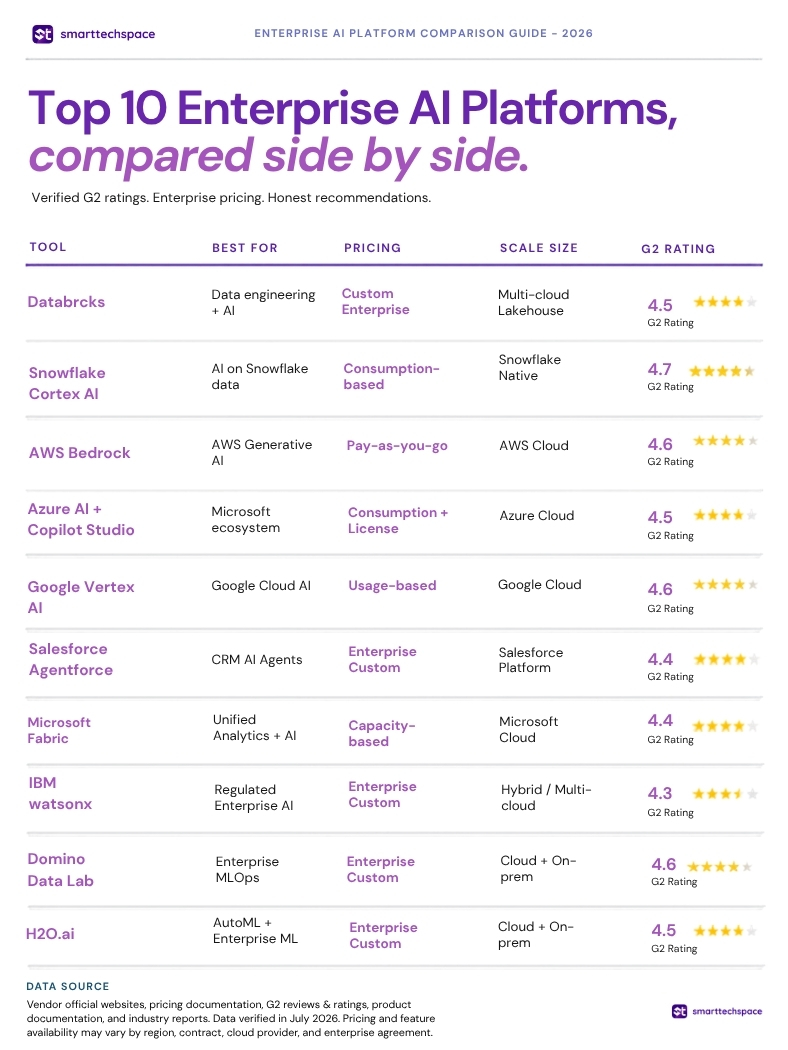
The 10 Best Enterprise AI Platforms in 2026
1. Databricks — Best for Data-Heavy Teams
Databricks is an enterprise AI platform built around the “lakehouse” architecture, designed to help organizations process large-scale data, build analytics pipelines, and operationalize machine learning in a single environment.
At its core, it extends Apache Spark into a fully managed enterprise AI infrastructure platform and layers collaboration, governance, and ML tooling on top. This makes it particularly strong for data-heavy teams that need to handle massive datasets without stitching together multiple fragmented systems.
Key Features:
- Lakehouse architecture: Combines data lakes (flexibility, low-cost storage) with data warehouses (performance, reliability). This reduces duplication between storage and analytics systems.
- Distributed processing with Spark: Scales computation across clusters for ETL, streaming, and batch workloads.
- Collaborative notebooks: Data engineers, analysts, and data scientists can work in the same environment using Python, SQL, Scala, or R.
- ML lifecycle management (MLflow): Built-in tools for tracking experiments, packaging models, and deploying machine learning systems.
- Governance (Unity Catalog): Centralized access control and data lineage across the platform.
- Cloud-native design: Runs on AWS, Azure, and Google Cloud with managed infrastructure.
In short, it’s aimed at replacing a patchwork of separate data engineering, warehousing, and ML tools with a single integrated platform.
Databricks remains one of the best enterprise AI platforms in 2026 for organizations with advanced data engineering requirements.
Skip if your team is small or your workloads are SQL-only.
2. Snowflake Cortex AI — Best If Your Data Already Lives in Snowflake
Snowflake Inc. Cortex AI is Snowflake’s built-in generative AI layer that lets you apply LLMs, semantic search, and AI-powered analytics directly on data stored in Snowflake without moving it to external tools.
Cortex AI is designed to turn the Snowflake platform into enterprise AI software, where you can query, analyze, and build AI applications using natural language, SQL, or APIs.
Key Features:
- Natural Language → SQL (Cortex Analyst): Ask business questions in plain English and auto-generate SQL queries.
- Cortex Search: Hybrid keyword + vector search across structured and unstructured data.
- AI Functions (AISQL): Built-in LLM tasks like summarization, classification, extraction, and translation directly in SQL.
- Cortex Agents: Multi-step AI workflows combining search, reasoning, and data queries.
- Multi-model support: Access to models like OpenAI, Anthropic, Llama, and Mistral.
- Enterprise AI governance: Secure, compliant AI with role-based access and no data movement.
Cortex AI turns Snowflake from an enterprise data platform into an AI-enabled data platform, where you can ask questions, build AI apps, and automate insights directly on your existing datasets.
Best for: Snowflake-centric companies running AI-powered analytics.
Skip if your data is fragmented or you need full custom ML.
3. AWS Bedrock — Best for AWS Shops
Amazon Web Services Amazon Bedrock is a fully managed enterprise generative AI platform that lets you build your enterprise AI platform using foundation models (FMs) from leading AI providers without managing infrastructure or training models from scratch.
Amazon Bedrock provides a single API layer to access multiple large language models (LLMs) and foundation models, making it easy to integrate generative AI into applications.
Key Features:
- Multi-model access (single API): Use models like Anthropic Claude, Amazon Titan, Meta Llama, Cohere, Mistral, etc.
- Serverless infrastructure: No GPU provisioning or model hosting required; fully managed scaling.
- RAG (Knowledge Bases): Connect enterprise data for context-aware, accurate AI responses.
- Agents for automation: Build autonomous AI agents that can reason, call APIs, and execute workflows.
- Model customization: Fine-tune or adapt models using private enterprise data
- Enterprise AI Security: IAM integration, encryption, and AWS compliance controls.
AWS Bedrock is a serverless enterprise generative AI platform that unifies access to leading foundation models and enables secure, scalable AI application development with built-in enterprise tooling.
AWS Bedrock is among the best enterprise AI platforms in 2026 for enterprises already invested in the AWS ecosystem.
Skip if you’re not on AWS; the value drops fast.
4. Azure AI + Copilot Studio — Best for Microsoft-Stack Companies
Microsoft Azure AI + Copilot Studio is Microsoft’s business AI platform that combines powerful AI models with low-code tools to help organizations build, customize, and implement enterprise AI and automation agents.
At a high level, Azure AI provides the underlying foundation models and AI services, while Copilot Studio lets users quickly build conversational AI assistants and workflow agents without deep coding.
Key Features:
- Foundation AI Models (Azure OpenAI Service): Use GPT-class models for chat, reasoning, summarization, and generation.
- Prebuilt AI Services (Azure AI): Language, vision, speech, translation, and document intelligence APIs.
- Low-Code Copilot Builder: Microsoft Copilot Studio enables creation of AI copilots without heavy coding.
- Enterprise Data Integration: Connects to Microsoft 365, Dataverse, SharePoint, and external APIs for grounded responses.
- Agent & AI Workflow Automation: Build autonomous AI agents that can execute tasks, call APIs, and orchestrate multi-step workflows.
- Security & Governance: Enterprise-grade controls with Azure identity and compliance.
Azure AI + Copilot Studio is a unified Microsoft platform for building secure, low-code AI copilots and agents powered by foundation models and deeply integrated with enterprise data and workflows.
Best for: Companies already standardized on Microsoft 365.
Skip if you want model variety or you’re not on Microsoft.
5. Google Vertex AI — Best for Google Cloud Customers
Google Cloud Vertex AI is Google Cloud’s cloud-based AI platform that lets teams build, train, and deploy AI (including foundation models like Gemini) in a fully managed environment.
It brings together traditional ML workflows and modern GenAI capabilities into a single platform so developers and enterprises can move from experimentation to production faster.
Key Features:
- Unified ML + GenAI Platform: Single environment for training, deploying, and managing ML models and LLM-based applications.
- Access to Foundation Models (Gemini & others): Use Google’s latest LLMs (e.g., Gemini) for text, code, multimodal AI, and reasoning tasks.
- AI application development studio: Low-code interface to prototype prompts, chatbots, and generative applications quickly.
- MLOps End-to-End: Built-in pipelines for training, tuning, evaluation, deployment, and monitoring of models.
- Vector Search & RAG Support: Enables semantic search and retrieval-augmented generation over enterprise data.
- Enterprise Data Integration & Security: IAM-based access control, data encryption, and compliance within the Google Cloud ecosystem.
Vertex AI is Google Cloud’s end-to-end AI platform for building, deploying, and scaling both machine learning and generative AI applications using managed infrastructure and foundation models.
Best for: Google Cloud-native enterprises.
Skip if you’re on AWS or Azure; you’ll fight integration friction.
6. Salesforce Agentforce—Best for CRM-Powered AI
Salesforce Agentforce is Salesforce’s AI automation platform that enables organizations to build and deploy autonomous AI agents that can reason, take actions, and interact with business data and applications across the enterprise AI providers.
It extends Salesforce’s CRM capabilities by turning workflows and customer interactions into AI-driven, goal-oriented agents.
Key Features:
- Autonomous AI Agents: Build agents that can reason, plan, and execute multi-step business tasks.
- Native CRM Integration: Deep access to Salesforce Sales, Service, Marketing, and Commerce data for grounded decisions.
- Action-Oriented Execution: Agents don’t just respond—they can update records, trigger workflows, send emails, and create cases/opportunities.
- Data-Driven Intelligence: Powered by Salesforce Data Cloud to unify structured and unstructured enterprise data.
- Workflow Orchestration: Automates end-to-end AI-powered business processes across apps, APIs, and systems.
- Enterprise Security & Governance: Built-in access controls, compliance, auditability, and trust-layer enforcement.
Salesforce Agentforce is an enterprise AI agent platform that turns CRM data into autonomous agents capable of reasoning, taking actions, and automating end-to-end business processes.
Best for: Salesforce-heavy companies building customer-facing AI.
Skip if your AI workloads are mostly data engineering or non-CRM.
7. Microsoft Fabric — Best for Unified Analytics + AI
Microsoft Fabric is an end-to-end enterprise analytics platform that brings together data engineering, data integration, data warehousing, real-time analytics, and business intelligence into a single SaaS experience.
It is designed to simplify the modern data stack by eliminating the need for multiple separate tools and providing one integrated environment for working with data and analytics.
Key Features:
- Lakehouse architecture: Combines data lakes (flexibility, low-cost storage) with data warehouses (performance, reliability). This reduces duplication between storage and analytics systems.
- Distributed processing with Spark: Scales computation across clusters for ETL, streaming, and batch workloads.
- Collaborative notebooks: Data engineers, analysts, and data scientists can work in the same environment using Python, SQL, Scala, or R.
- ML lifecycle management (MLflow): Built-in tools for tracking experiments, packaging models, and deploying machine learning systems.
- Governance (Unity Catalog): Centralized access control and data lineage across the platform.
- Cloud-native design: Runs on AWS, Azure, and Google Cloud with managed infrastructure.
Best for: Microsoft-aligned companies that want one platform instead of three.
Skip if you need vendor neutrality or heavy ML depth today.
8. IBM watsonx—Best for Regulated Industries
IBM watsonx is IBM’s responsible AI platform designed to help organizations build, train, tune, and deploy AI models, including foundation models and traditional machine learning across governed enterprise data.
It is built specifically for enterprise-grade generative AI, data governance, and responsible AI at scale.
Key Features:
- Foundation AI Models (watsonx.ai): Build and use generative AI models for text, code, and business applications.
- Model Training & Fine-Tuning: Customize models on enterprise-specific data for domain accuracy.
- Data Foundation (watsonx.data): Scalable data lakehouse for structured and unstructured data management.
- AI Governance (watsonx.governance): Monitoring, risk management, bias detection, and regulatory compliance for AI systems.
- Enterprise Integration: Connects with existing IBM and multi-cloud environments for deployment.
- Responsible AI Framework: Built-in controls for transparency, explainability, and ethical AI usage.
IBM Watsonx is an enterprise AI software that unifies foundation models, data management, and AI governance to build and deploy responsible AI at scale.
Best for: Regulated enterprises with strict compliance needs.
Skip if you’re a fast-moving tech company optimizing for speed.
9. Domino Data Lab — Best for Regulated MLOps
Domino Data Lab is a machine learning operations platform that helps organizations build, run, and manage data science and machine learning workflows at scale in a governed, reproducible environment.
It is primarily focused on enabling data science teams to move from experimentation to production faster while maintaining control, collaboration, and compliance.
Key Features:
- End-to-End MLOps Platform: Supports the full ML lifecycle: experimentation → training → deployment → monitoring.
- Reproducible Data Science Workflows: Ensures experiments, code, data, and environments can be versioned and reproduced.
- Multi-Language Support: Works with Python, R, and other data science tools in a unified environment.
- Scalable Compute Infrastructure: Runs workloads on cloud, on-prem, or hybrid infrastructure with elastic scaling.
- Collaboration & Governance: Enables team collaboration with centralized control, access management, and auditability.
- Model Deployment & Monitoring: Streamlined model deployment with performance tracking and lifecycle management.
Domino Data Lab is an enterprise MLOps platform that enables scalable, reproducible, and governed machine learning lifecycle management from development to production.
Best for: Regulated enterprises with mature data science teams.
Skip if you’re not regulated or you need an end-to-end platform.
10. H2O.ai — Best for AutoML and Tabular Data
H2O.ai is an enterprise ML platform that provides automated machine learning (AutoML), a generative AI platform, and model deployment capabilities to help organizations build and operationalize AI systems quickly and at scale.
It is designed to simplify the end-to-end ML lifecycle so both data scientists and non-experts can create production-ready AI models with minimal manual effort.
Key Features:
- Automated Machine Learning (AutoML): Automatically builds, tunes, and selects the best ML models with minimal manual effort.
- Generative AI Capabilities: Supports LLM-based applications, chatbots, and enterprise GenAI use cases.
- Model Explainability (XAI): Provides transparent, interpretable models for trust and regulatory compliance.
- End-to-End MLOps Support: Covers model training, validation, deployment, and monitoring in production.
- Scalable Deployment: Deploys models across cloud, on-prem, and hybrid environments.
- Enterprise Integration: Connects with existing data lakes, warehouses, and enterprise systems.
H2O.ai is an AI platform for enterprises that combines AutoML, generative AI, and MLOps to help organizations rapidly build, deploy, and scale explainable AI solutions.
Best for: Finance, insurance, and analytics teams with tabular ML use cases.
Skip if you’re LLM-first and don’t have classic ML workloads.
How to Pick in 5 Minutes (Real Framework)
When evaluating the best enterprise AI platforms in 2026, skip the 30-page RFP and focus on your cloud, data, and business objectives. Here’s the fastest way to narrow down.
Step 1 — Where does your data live? – AWS → Bedrock – Azure / Microsoft 365 → Azure AI – Google Cloud → Vertex AI – Snowflake → Cortex AI – Spread across multiple → Databricks
Step 2 — What’s your main AI use case? – Sales/service automation: Salesforce Agentforce – Tabular ML (churn, fraud, forecasting): H2O.ai or Vertex AI AutoML – Enterprise AI applications: Bedrock, Azure AI, Vertex AI, Databricks – Regulated workloads → IBM watsonx or Domino
Step 3 — How regulated is your industry? – Heavily (banking, healthcare, public sector) → watsonx or Domino – Moderately → Databricks or your cloud-native platform – Lightly → any platform that fits steps 1-2
That’s it. Three questions. Most companies should land on a clear answer in under 5 minutes.
5 Mistakes That Kill Enterprise AI Projects
These show up in nearly every failed rollout:
- Picking the platform before defining the use case. “We need AI” is not a project. “Cut customer support response time by 40% in 90 days.”
- Choosing for technical feasibility, not business impact. The hardest use case is rarely the right first one. Pick the boring one that ships in 90 days.
- Underbudgeting integration. The platform is 10% of the work. Connecting it to your other systems is 90%.
- Skipping change management. People hate when their workflows change. Plan for it. Train. Communicate.
- Locking into one vendor too early. Pick platforms that support open formats (Delta Lake, Iceberg). Multi-cloud is normal in 2026.
Final Verdict
The best enterprise AI platforms in 2026 in this guide cover every real enterprise AI solution in 2026. There’s no single winner. There are only the right enterprise AI solutions for your stack
The fastest path forward:
- Choose business AI platforms that match your existing infrastructure that runs next to your data.
- Define one measurable use case for the first 90 days.
- Run a real proof-of-concept, not a demo.
- Decide based on time-to-first-result, not feature lists.
That’s how teams actually ship enterprise AI in 2026. Everything else is a slide deck.
Next step: Pick your top two from this list of the best enterprise AI platforms in 2026 and run a 60-day proof of concept before making your final decision. Run a 60-day POC with each on your highest-impact use case. Bring your data engineer, your ML engineer, and one business stakeholder to each evaluation. Decide on outcomes, not promises.
FAQs:
What’s the single best enterprise AI platform among the best enterprise AI platforms in 2026?
There isn’t one. The best platform depends on your cloud, your data location, and your use case. For most enterprises, the right choice is whatever runs next to their existing data.
How much should we budget for enterprise AI?
A reasonable year one range is $500K to $2M for mid-large enterprises. Add 30 to 50 percent more for integration and operations. Most teams underbudget by 40 to 60 percent in year one.
Databricks vs. Snowflake — which one wins?
Different jobs. Databricks wins for end-to-end ML pipelines and complex data engineering. Snowflake Cortex AI wins for SQL-native LLM functions on Snowflake data. Many enterprises run both.
Should we use one AI platform or several?
Several is now normal. Most enterprises run 2 to 3 platforms—a primary cloud platform, a data + AI platform, and a domain-specific platform like Agentforce. Standardize on open formats to avoid lock-in.
How are AI agents different from regular ML models?
ML models predict (this email is spam; this customer will churn). Agents act — they reason about goals, plan steps, use tools, and execute. Almost every platform on this list now has an agent framework.
What’s the biggest risk with enterprise AI in 2026?
Vendor lock-in. The platforms making it hardest to leave are also the ones moving fastest. Build with portability in mind: open formats, model-agnostic apps, and exportable trained models.
2 Comments
Pingback: Best Enterprise AI Agent Platforms in 2026: Compared on Governance, Not Demos - smarttechspace
Pingback: Snowflake Pricing 2026: Credits, Costs and Real Bills