

A year ago, most “AI agents” in the enterprise were chat assistants with a new label. In 2026 the platforms have caught up. Agents can now read company data, call APIs, update records and hand work to other agents.
That is exactly why the platform decision matters. Once an agent can act inside your systems, the questions change from “How clever is it?” to “Who is it? What can it touch, and can we see and stop what it does?”
This guide compares eight enterprise AI agent platforms on seven governance controls, grouped by the stack you already run. It is written for CTOs, CISOs and architects who will own these agents once they go live.
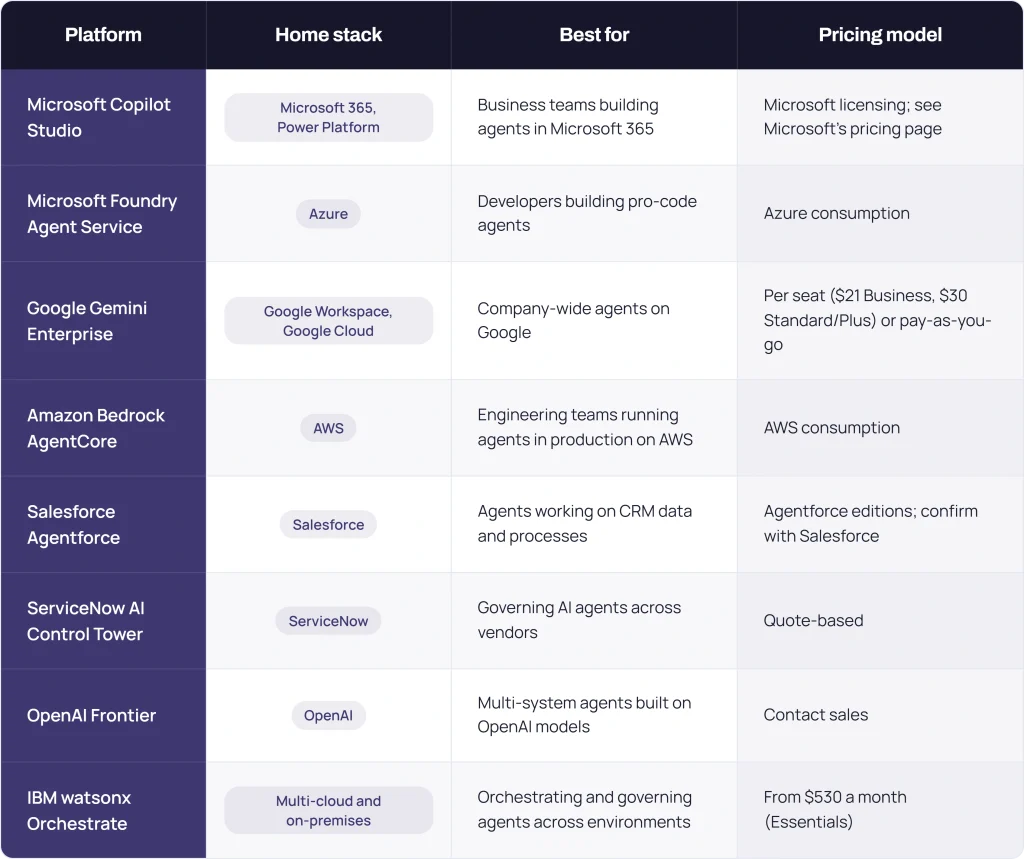
| Quick answer: The best enterprise AI agent platform is usually the one built around the systems your agents need to act in. Microsoft shops should look at Copilot Studio for business builders and Foundry Agent Service for developers. AWS teams should start with Bedrock AgentCore, Google Workspace and Cloud teams with Gemini Enterprise, and Salesforce-centric teams with Agentforce. ServiceNow AI Control Tower and IBM Watsonx Orchestrate focus on governing agents across vendors, and OpenAI Frontier is the model-provider option. |
The 8 platforms at a glance
What makes enterprise AI agent platforms different from chatbots?
An enterprise AI agent platform is a managed environment for building, running and governing AI agents that take actions in business systems. Three tests separate a real platform from a chatbot with a new name:
- Can the agent act? It must be able to call tools, APIs or workflows, not only answer questions.
- Can you scope it? Each agent needs its own identity and permissions, separate from the person who built it.
- Can you see it? Every action should be logged and traceable after the fact.
Developer frameworks such as LangGraph and CrewAI are different. They are code your team runs and governs itself. Several platforms below, including Bedrock AgentCore and Foundry Agent Service, can host agents built with those frameworks.
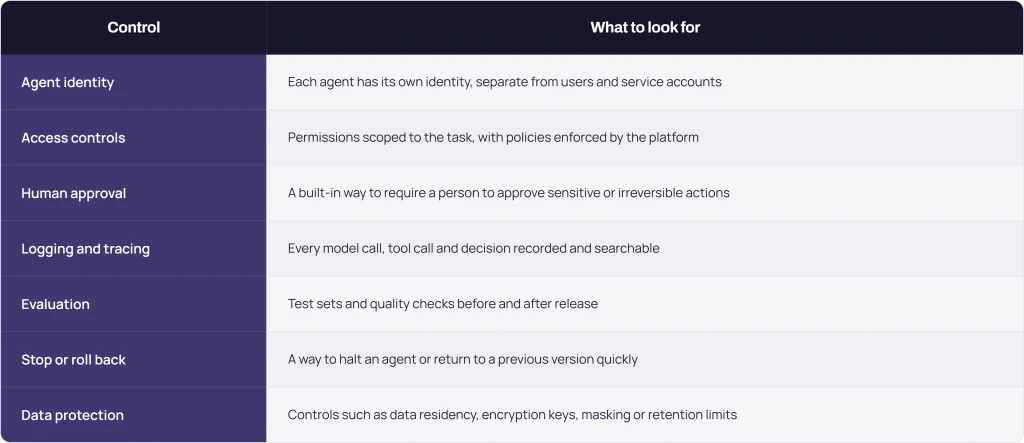
The 7 governance controls we compared
Governance coverage matrix
Each mark reflects what the vendor documents publicly, checked on 7 October 2026. A dash means we did not find it in the documentation we reviewed. It does not prove the feature is missing, so ask in the demo.
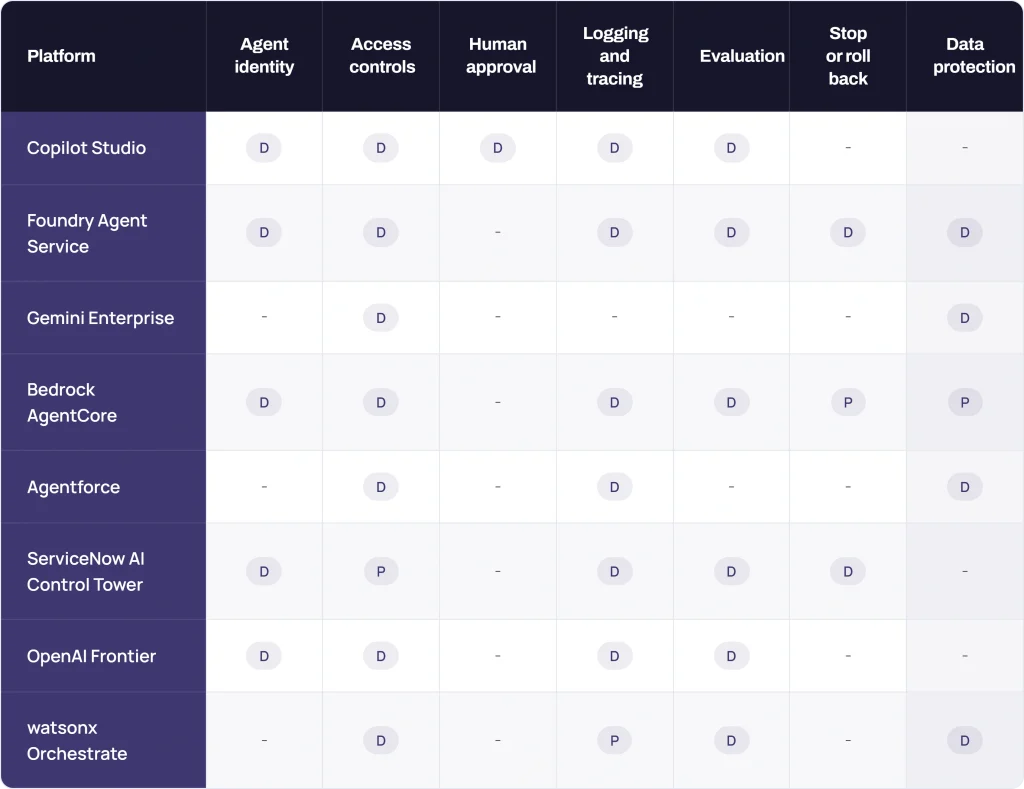
D = documented. P = partial. A dash means ‘not found’ in public documentation on 7 October 2026.
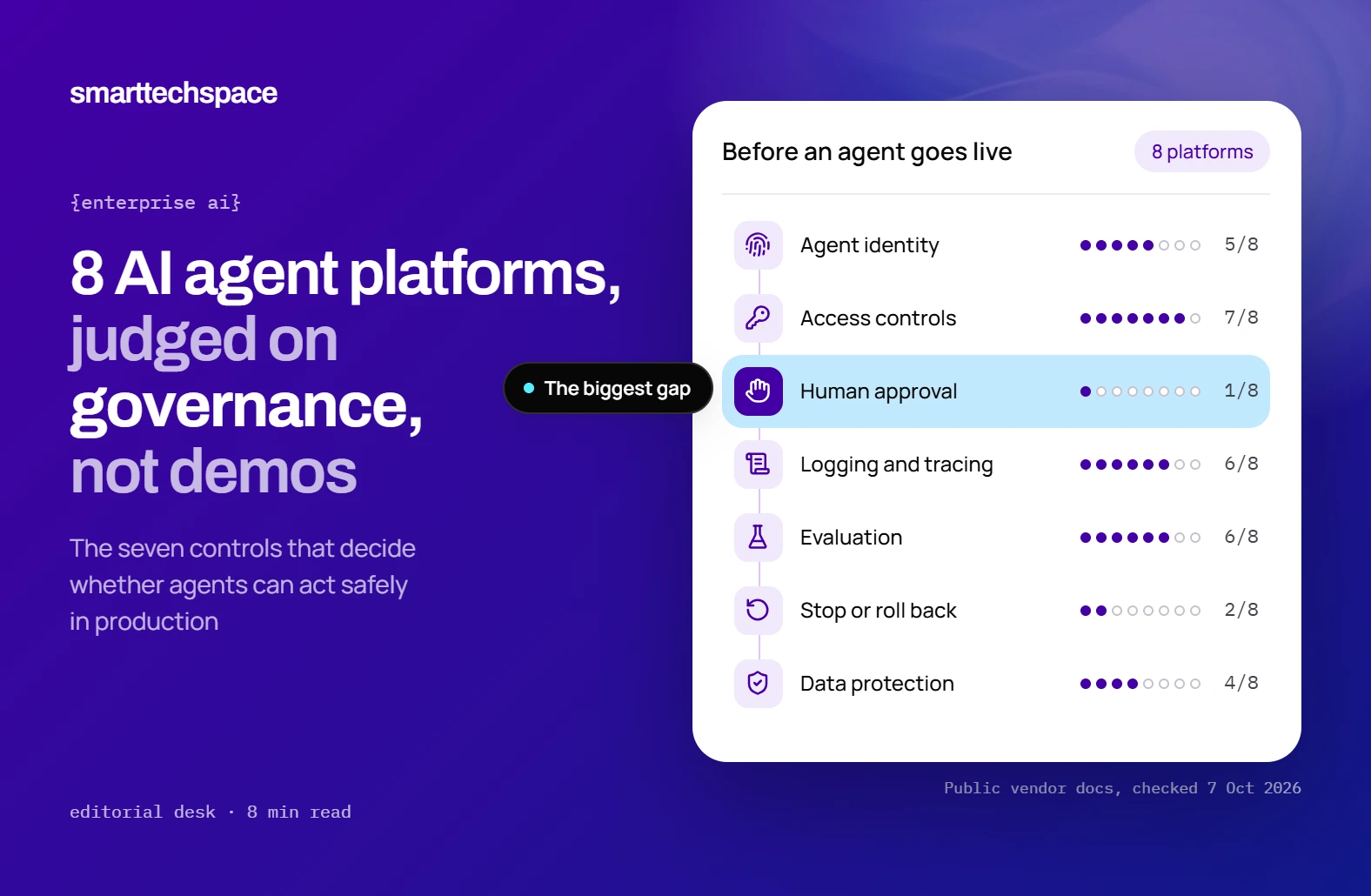
The clearest gap across the market is human approval. Only Copilot Studio clearly documents human-in-the-loop steps in its workflows among the material we reviewed. If your agents will take irreversible actions, such as sending money, deleting records or emailing customers, make the approval step a requirement in every demo.
If you run Microsoft
Microsoft Copilot Studio
Copilot Studio is Microsoft’s low-code tool for building agents and workflows that publish into Teams, Microsoft 365 Copilot, websites and apps. Workflows include built-in testing and human-in-the-loop controls, and admins get analytics, evaluations and an agent inventory with role-based access.
Identity is a strong point. Each agent built in Copilot Studio receives its own Microsoft Entra Agent ID, which is generally available, and agent activity is logged in the Entra admin centre. Microsoft notes that some extended agent security features require a Microsoft Agent 365 licence.
- Best for: business teams building agents that work across Microsoft 365.
- Watch for: confirm which identity and security features need extra licences.
- Lock-in: high, by design. Agents are built around Microsoft 365 data and identity.
Microsoft Foundry Agent Service
Foundry Agent Service is the pro-code option on Azure. Each agent can have a dedicated Microsoft Entra identity, access is controlled through Azure role-based access control, and agents can run inside your own virtual network. It traces every model call and tool call, runs evaluations, keeps automatic version snapshots you can roll back to, and supports MCP servers as tools.
- Best for: engineering teams building custom agents on Azure.
- Watch for: several agent types and features were still in preview at the time of review.
- Lock-in: moderate. It supports multiple models and frameworks such as LangGraph.
If you run Google
Google Gemini Enterprise
Gemini Enterprise lets employees discover, build and run agents, including through a no-code Workflow Builder, with developers using Google’s Agent Development Kit. Google lists centralised control over agents, permissions and policies; Model Armour screening for prompt injection; and data controls, including VPC Service Controls, customer-managed encryption keys and data residency. Connectors reach Google Drive, OneDrive, SharePoint, HubSpot and Jira.
- Best for: companies on Google Workspace or Google Cloud that want agents for many employees.
- Watch for: logging, evaluation and rollback were not detailed on the product page we reviewed; check the admin documentation.
- Pricing: Business edition $21 per seat a month (up to 300 seats), Standard and Plus $30, or pay-as-you-go.
If you run AWS
Amazon Bedrock AgentCore
Bedrock AgentCore is a set of modular services for running agents in production. It includes a serverless runtime with session isolation, identity that works with Okta, Microsoft Entra ID, Cognito and Auth0, a gateway that turns APIs and Lambda functions into MCP tools, a policy service that checks tool calls before they run, OpenTelemetry-based observability and an evaluations service. It supports MCP and Agent-to-Agent (A2A) and works with any framework or model.
- Best for: engineering teams that want production-grade controls and their choice of framework.
- Watch for: it is a toolkit, not a no-code builder. Plan for developer time.
- Lock-in: moderate. Agents can use open frameworks and outside models.
If your work lives in Salesforce or ServiceNow
Salesforce Agentforce
Agentforce agents work directly on CRM data and processes. Admins define each agent’s role, data, actions, guardrails and channels. The Einstein Trust Layer adds grounding in CRM data, masking of sensitive data, toxicity detection, an audit trail and zero data retention agreements with third-party model providers.
- Best for: agents that need to act on customer, sales and service records.
- Watch for: confirm agent identity and evaluation tooling with Salesforce, as they were not covered in the material we reviewed.
- Pricing: Agentforce editions; confirm current packaging with Salesforce.
ServiceNow AI Control Tower
AI Control Tower is a governance layer rather than a builder. ServiceNow says it automatically inventories AI agents, models and MCP servers from ServiceNow and third parties, tracks AI identity and access, blocks prompt injection, monitors performance through metrics and log traces, and can stop an agent. It includes pre-built content for the NIST AI Risk Management Framework and the EU AI Act.
- Best for: companies that need one governance view across agents from several vendors.
- Watch for: you still build agents elsewhere or with ServiceNow AI Agents.
- Pricing: quote-based.
Model-provider and cross-vendor platforms
OpenAI Frontier
OpenAI launched Frontier on 6 February 2026 to move agents from pilots into production. It gives each agent an identity with access scoped to its task, connects business systems through a shared context layer, and includes detailed logs and evaluation loops. Named early adopters include HP, Intuit, Oracle, State Farm, Thermo Fisher and Uber.
- Best for: companies standardising on OpenAI models across many systems.
- Watch for: confirm availability, pricing and model choice for your region.
- Pricing: contact OpenAI sales.
IBM Watsonx Orchestrate
watsonx Orchestrate builds, orchestrates and governs agents, including agents running in other environments such as Amazon Bedrock. IBM lists consistent policies and access controls across agents, evaluation from user feedback and metrics, token and cost tracking, and policies for sensitive and personal data. It runs on IBM Cloud, AWS or on-premises.
- Best for: organisations with agents spread across clouds that need one control plane.
- Watch for: the Premium tier is the one IBM positions for data isolation in regulated environments.
- Pricing: Essentials from $530 a month and Standard from $6,360 a month, per IBM’s product page.
Six questions to ask enterprise AI agent platforms in a demo
- Show us an agent’s identity in our directory. How is it created, and how is it removed?
- How do we limit what one agent can read and change, and where are those rules enforced?
- How do we require a person to approve a specific action before it runs?
- Show us the log of a completed task, including every tool call.
- How do we stop a misbehaving agent, and how fast can we return to the previous version?
- Where is our data processed and stored, and which models can we choose?
Watch how long each answer takes. Controls that are real can be shown in the product in a minute or two. Controls that need a slide deck usually need more work.
How to choose: a simple decision path
- Start with the system of record. If most agent work happens in one platform, such as Salesforce, ServiceNow or Microsoft 365, begin with its native option.
- Then look at your cloud. Custom agents usually belong on the cloud, where your data and identity already sit.
- Then check governance gaps. Score your shortlist on the seven controls and close gaps with a governance layer if needed.
- Finally, plan your exit. Prefer platforms that support open protocols such as MCP and A2A and open frameworks, so agents can move later.
For background on how agents work, read our guides to enterprise AI agents and AI workflow agents. If you are comparing the data platforms underneath, see the best enterprise AI platforms. For the executive view on policy, TechsterHub’s AI governance framework covers the board-level side.
FAQs:
What is the difference between an AI agent platform and an agent framework?
A platform is a managed service with identity, permissions, logging and hosting built in. A framework such as LangGraph or CrewAI is code your team runs, secures and monitors itself.
Which AI agent platform is best for Microsoft 365 companies?
Copilot Studio for business builders, because agents use Microsoft 365 data and get their own Entra identity. Developer teams can add Foundry Agent Service for custom agents on Azure.
How should we govern AI agents?
Give each agent its own identity, scope its access to the task, require approval for irreversible actions, log every action and keep a tested way to stop or roll back an agent.
Do AI agent platforms support MCP?
Support is spreading. Foundry Agent Service and Bedrock AgentCore both document MCP support, and ServiceNow AI Control Tower inventories MCP servers. Check each vendor’s current documentation.
How are enterprise AI agent platforms priced?
Most use consumption pricing based on usage, sometimes on top of seat licences. Model your expected volume before signing, since agent workloads can grow fast.