

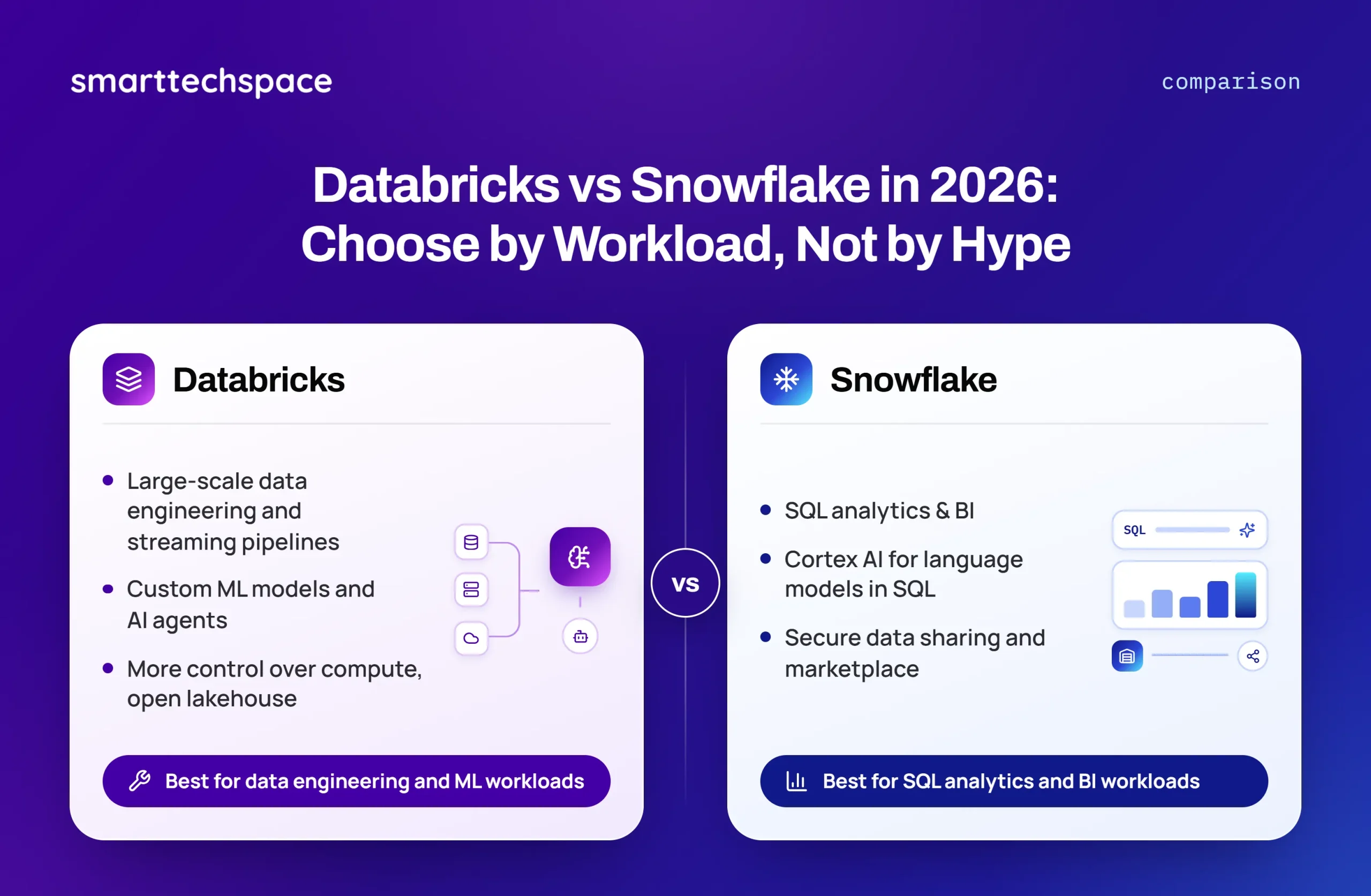
Five years ago the answer was simple. Snowflake was the cloud data warehouse for SQL analytics. Databricks was the platform for data engineering and machine learning on Spark. Each vendor has since spent heavily on the other’s home ground, and today both offer SQL warehousing, data engineering, governance, open table formats, and AI.
That overlap is why Databricks vs Snowflake comparisons that list features side by side rarely help. Both lists are long and mostly the same. The useful question is which platform is the better starting point for your main workload, your team’s skills, and the way you want to be billed.
| Quick verdict: Start with Snowflake if most of your work is SQL analytics and BI for many business users, you want minimal tuning, and you value simple, fully managed operations. Start with Databricks if your core work is large-scale data engineering, machine learning, or AI built in Python and notebooks, and you want more control over compute. Many larger companies run both, using an open table format such as Apache Iceberg so both can read the same data. |
Why the two platforms now overlap
Snowflake started as a managed SQL warehouse and added Python through Snowpark, Apache Iceberg tables, and Cortex AI for language models on governed data. Databricks started from Apache Spark and the lakehouse idea, then added a serverless SQL warehouse, Unity Catalog, for governance and model serving for AI.
The result is two platforms that can each handle most data work, with different defaults. Snowflake defaults to simplicity: you choose a warehouse size, and it manages the rest. Databricks defaults to flexibility: you choose compute types and cluster settings and, on classic compute, run inside your own cloud account.
The Databricks vs Snowflake workload decision table
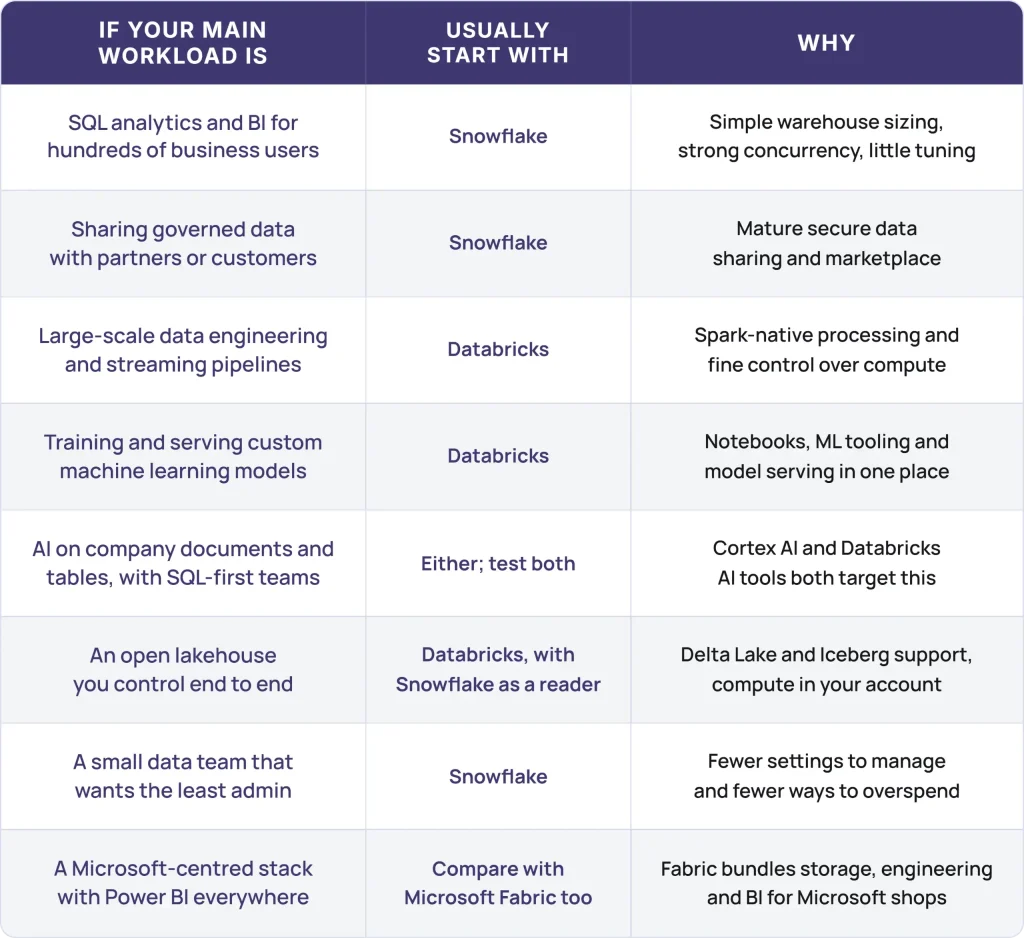
Use the table as a starting point, then test your two or three heaviest real workloads on both platforms before committing.
Databricks vs. Snowflake pricing: how each bill works
Both platforms bill for usage by the second, but they measure it differently.
Snowflake bills compute in credits. Each warehouse size uses a fixed number of credits per hour, doubling with each size up, and the price per credit depends on edition and region: on demand in AWS US East, it ranges from $2 on Standard to $6 on Virtual Private Snowflake. Storage is billed per terabyte per month. Our Snowflake pricing guide works through three monthly bills.
Databricks bills in Databricks Units (DBUs), a normalized measure of processing power, at rates that vary by product, compute type, and cloud, according to its pricing page. It offers pay-as-you-go and discounted committed-use contracts. On classic compute, the cloud provider also bills you separately for the virtual machines in your own account, so a Databricks bill often has two parts.
That second bill is why a direct per-unit comparison misleads. Compare the total cost of running the same workload for a month, including cloud infrastructure, on both platforms.
What companies spend on each
Vendr’s purchase data, updated February 2026, shows how different typical deals are. The median annual Databricks contract is about $339,300, with recorded deals from about $31,920 to $1,953,047. The median Snowflake contract is about $100,000, with recorded deals from about $20,000 to $600,000. Average negotiated savings are about 13% for Databricks.
The gap mostly reflects who buys each platform and for what. Databricks deals often cover large engineering and machine learning programs. Do not read the medians as one platform being three times the price of the other for the same work. Sources: Vendor pages for Databricks and Snowflake.
Open formats and lock-in
Open table formats have changed how much the choice locks you in. Databricks built Delta Lake and supports Apache Iceberg. Snowflake supports Iceberg tables that other engines can read. Storing core data in an open format means you can query it from more than one engine, switch tools for a given workload later, or run both platforms on the same data.
Lock-in still exists, but it now sits mostly in pipelines, governance setup, notebooks, and skills rather than in the data itself. Factor the cost of rebuilding those into any future switch.
AI and agents on each platform
Both vendors now pitch themselves as the place to build AI on company data. Snowflake’s Cortex AI runs language models and AI functions inside Snowflake, billed in credits, and its natural-language agent experience lets business users ask questions of their data. Databricks offers model serving, tools for building and evaluating agents, and governance of models and data through Unity Catalog.
For SQL-first teams that want AI on governed tables with little engineering, Snowflake is often faster to start. For teams building custom models or complex agent systems, Databricks usually offers more control. If agents will act on your systems, read our guide to AI agent governance before going live.
When to run both
Running both is a common answer to Databricks vs Snowflake in larger companies, and it is not a failure to choose. A typical split uses Databricks for heavy data engineering and machine learning, writes curated data to an open format, and serves BI and data sharing from Snowflake. The cost is two contracts, two governance models, and two sets of skills, so make it a deliberate design with clear ownership, not an accident of departmental buying.
Five questions to settle the decision
- What share of our compute will be SQL analytics versus engineering and machine learning?
- Do our people work mainly in SQL, or in Python and notebooks?
- Do we want a fully managed service, or more control over compute in our own cloud account?
- What does the same real workload cost per month on each, including cloud infrastructure?
- Will we store core data in an open format so we keep the option to use both?
For the full picture on each side, read our Databricks review, and see our list of the best enterprise AI platforms.
FAQs:
Databricks vs. Snowflake: Which is better?
Neither is better for everything. Snowflake is usually the stronger start for SQL analytics and BI, and Databricks for data engineering and machine learning.
Is Databricks more expensive than Snowflake?
Vendr’s median Databricks contract is higher, but deals differ in scope. Compare the monthly cost of the same workload on both, including cloud infrastructure.
How does Databricks pricing work?
Databricks bills in Databricks Units by the second, at rates that vary by product and compute type. On classic compute, your cloud provider also bills for the machines.
How does Snowflake pricing work?
Snowflake bills compute in credits by the second, with credits per hour set by warehouse size and the price per credit set by edition and region.
Can Snowflake and Databricks work together?
Yes. Many companies store core data in an open format such as Apache Iceberg and use each platform for the workloads it suits best.
Where does Microsoft Fabric fit?
Fabric is Microsoft’s bundled analytics platform. Companies that are standardized on Microsoft and Power BI should compare it with both.