

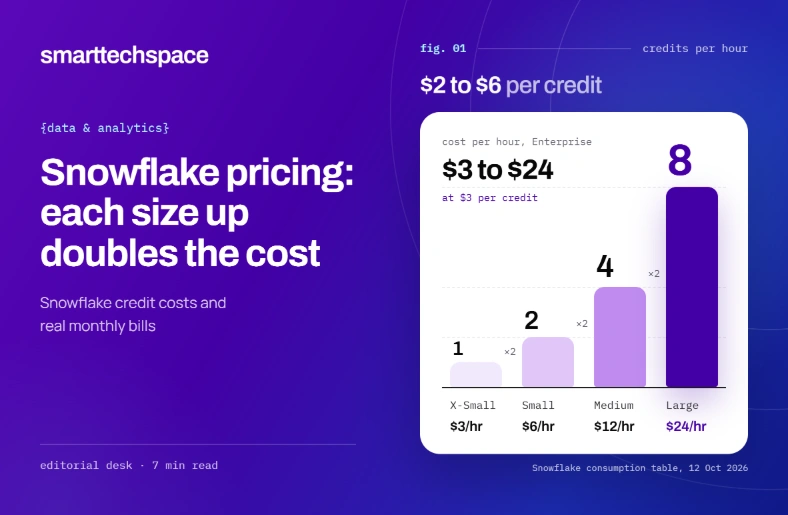
Snowflake pricing confuses people because there is no monthly plan price. You buy credits, warehouses burn credits by the second, and the dollar value of a credit changes with your edition, cloud and region. Finance wants one number. The pricing page gives you a model.
This guide turns Snowflake pricing into numbers you can use. It uses Snowflake’s own Service Consumption Table, effective 12 October 2026, plus purchase data from Vendr, a software buying platform, to show what a credit costs, how fast each warehouse size uses them, and what three realistic teams would pay each month.
| Quick answer: Snowflake pricing is usage-based. Compute is billed in credits, and on-demand in AWS US East a credit costs $2 on Standard, $3 on Enterprise, $4 on Business Critical and $6 on Virtual Private Snowflake. Warehouses use 1 credit an hour at X-Small, doubling with each size up. Storage is billed per terabyte per month. According to Vendr’s purchase data, the median annual Snowflake contract is about $100,000, with recorded deals from about $20,000 to $600,000. |
Snowflake cost per credit by edition
Snowflake’s Service Consumption Table lists these on-demand prices for AWS US East (N. Virginia):
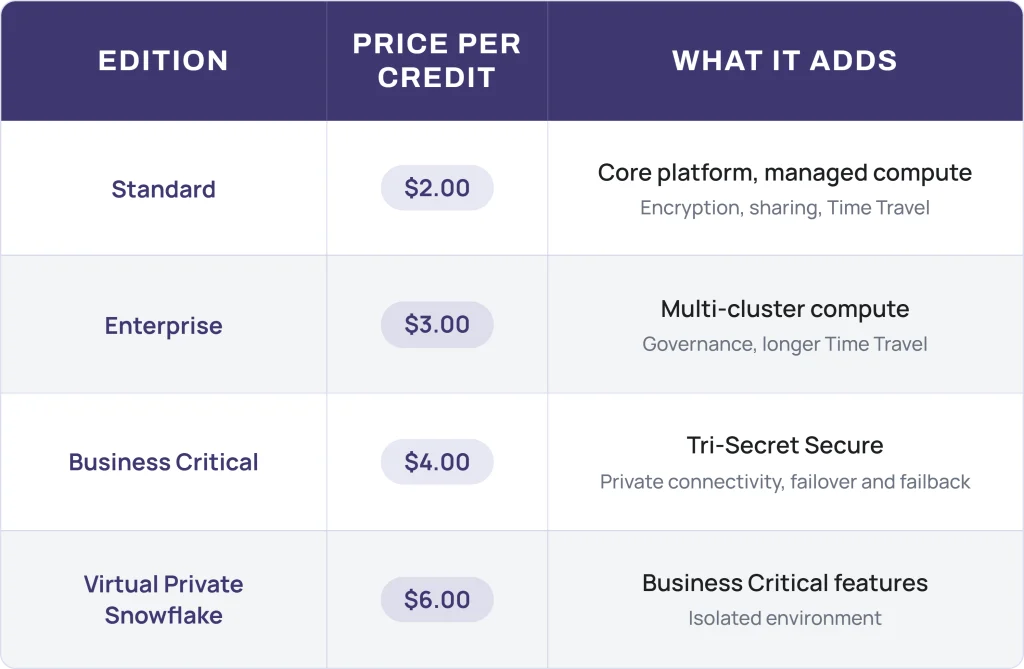
Prices differ by cloud and region, and pre-paid capacity contracts usually lower the rate per credit. Always check the table for your own region before budgeting.
Snowflake warehouse sizes and credits per hour
A virtual warehouse is the compute cluster that runs your queries. Each size up doubles both power and credits per hour, according to Snowflake’s warehouse documentation.
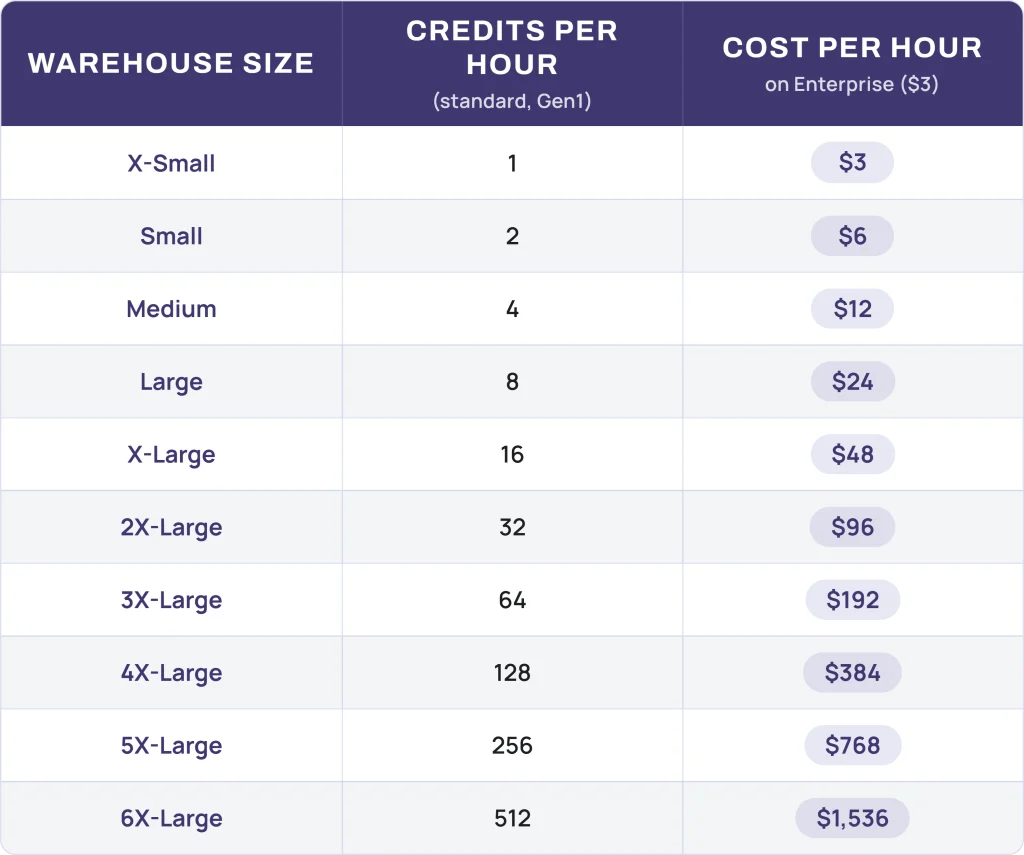
Billing is per second, with a 60-second minimum each time a warehouse starts or resumes. Auto-suspend and auto-resume are on by default, so a warehouse stops using credits when it is idle.
A simple Snowflake pricing calculator
| Monthly compute formula: Monthly compute cost = credits per hour for the warehouse size × hours running per day × days per month × price per credit. Repeat for each warehouse, then add storage and any serverless features. |
Use this worksheet with your own numbers:
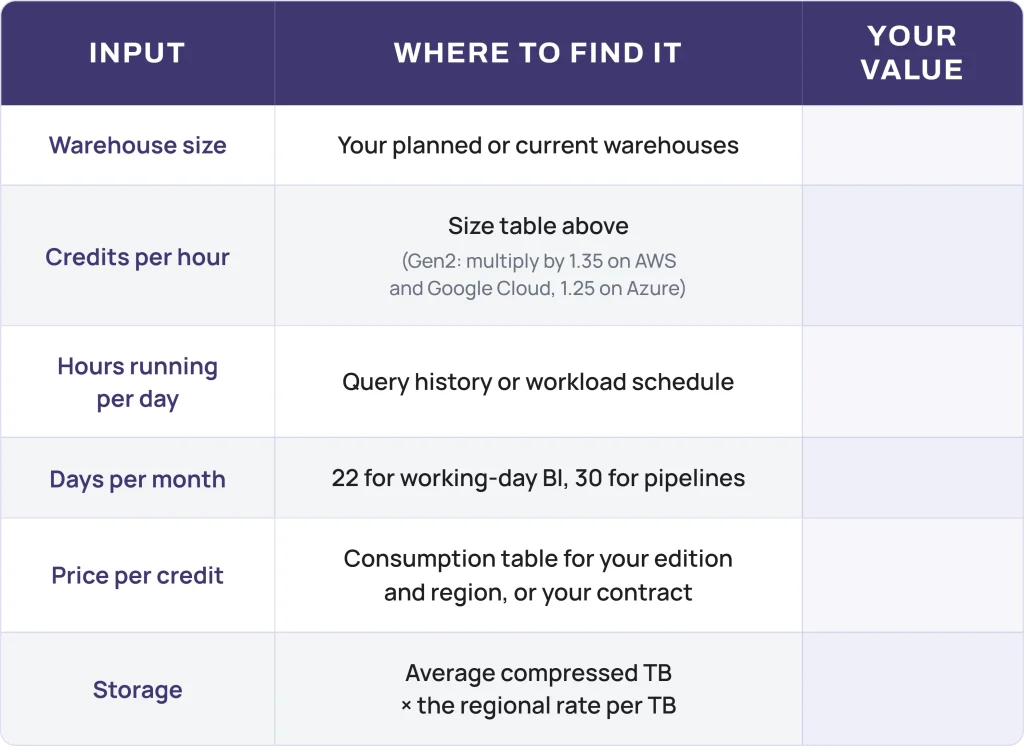
Two pieces of small print change real bills. Cloud services, such as query compilation and metadata, are charged only when they exceed 10% of that day’s warehouse usage, according to Snowflake’s compute cost guide. Serverless features, such as Snowpipe and automatic clustering, are billed as their own line items.
Three worked Snowflake monthly bills
These examples use Enterprise edition at $3 per credit on AWS US East, standard Gen1 warehouses, and compute only. They illustrate the method and are not quotes.
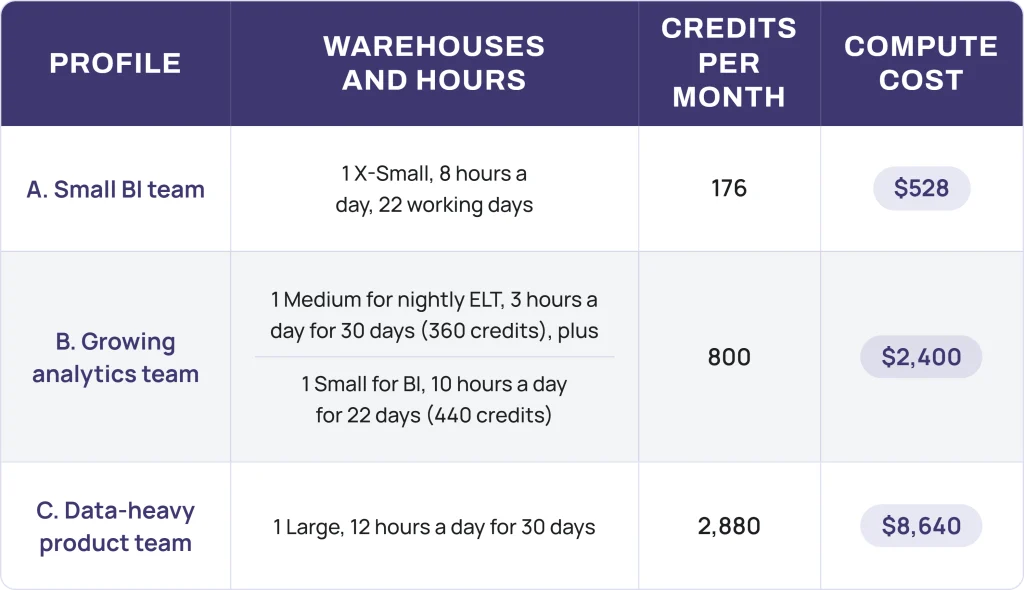
Monthly compute cost ranges from $528 for a small team to $8,640 for a data heavy product team.
What companies pay per year on contract
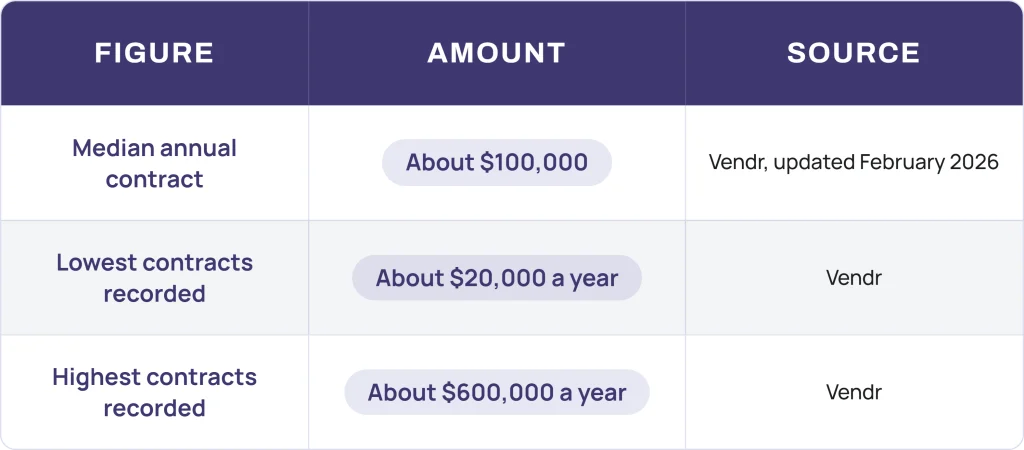
On contract, Snowflake pricing usually works through pre-paid capacity: you commit to a credit volume in exchange for a lower rate per credit. Commit to what your pilot data supports, not to a growth forecast, because unused capacity is money spent.
Snowflake Gen2 cost: when the higher rate saves money
Gen2 standard warehouses, generally available since May 2025, use more credits per hour than Gen1. The current consumption table puts Gen2 at 1.35 times the Gen1 rate on AWS and Google Cloud, and 1.25 times on Azure. A Medium Gen2 warehouse on AWS uses 5.4 credits an hour instead of 4.
The other side is speed. Snowflake reported 2.1 times faster performance on core analytics and up to 4.4 times faster DELETE, UPDATE and MERGE operations than Gen1, on its own benchmarks. Because you pay for seconds used, Gen2 costs less on AWS whenever a workload runs at least about 26% faster, since 1 divided by 1.35 is 0.74. On Azure the break-even is 20%.
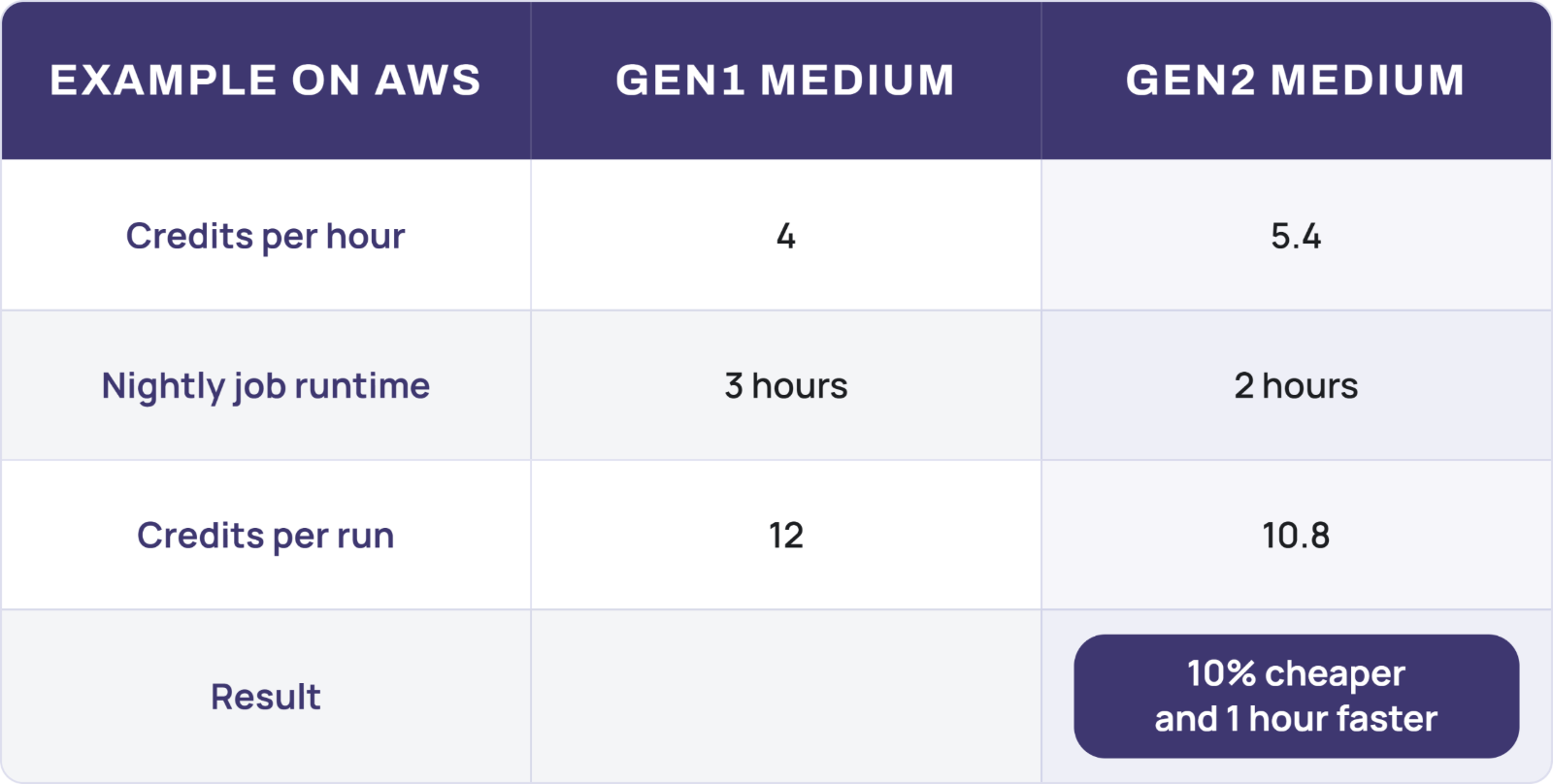
Test it on your heaviest jobs. Run the same workload on both for a week and compare credits used, not just speed.
Storage, Time Travel and data transfer costs
- Storage is billed monthly on the average compressed data you keep, at a per-terabyte rate listed for your region.
- Time Travel keeps earlier versions of changed or deleted data for a set period. Longer retention means more stored data.
- Fail-safe keeps a further recovery copy after Time Travel ends. You cannot query it, but it counts toward storage.
- Data transfer charges can apply when data leaves a region or cloud, for example during cross-region replication.
Staging tables reloaded every night can carry far more history than their current size suggests. Use transient tables for data you can easily reload, and keep long Time Travel only where you need it.
AI and Cortex pricing
Cortex AI brings large language models and AI functions to data inside Snowflake, billed in credits per token according to the consumption table. Snowflake’s natural-language agent experience, generally available since 4 November 2025 and now listed in Snowflake’s documentation as Snowflake CoWork, uses credits as well. AI features are disabled on trial accounts until a credit card is added, so budget a separate pilot for AI workloads.
If you plan to build agents on your data, see our guide to enterprise AI agent platforms and our list of the best enterprise AI platforms.
Six ways to keep Snowflake costs under control
- Right-size every warehouse. Start smaller than you think and size up only when queries queue or spill.
- Keep auto-suspend short for interactive warehouses.
- Give ELT, BI and data science their own warehouses so each cost is visible.
- Set resource monitors with notify and suspend thresholds below 100%, such as 90%, because suspension is not instant.
- Use budgets for serverless features. Resource monitors cover warehouses only.
- Review the 20 most expensive queries every month. Most savings come from a few queries.
Snowflake vs Databricks pricing
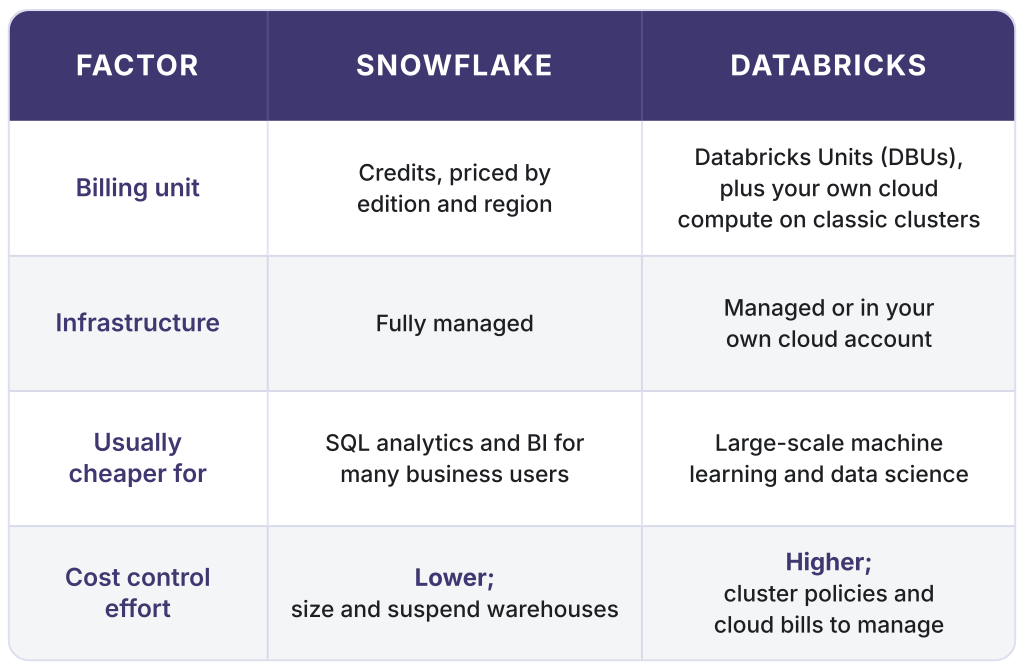
Compare by workload, not list price. Our Databricks review covers the other side in detail.
FAQs:
How much does a Snowflake credit cost?
On-demand in AWS US East, a credit costs $2 on Standard, $3 on Enterprise, $4 on Business Critical and $6 on Virtual Private Snowflake. Contracts and other regions differ.
How much does Snowflake cost per month?
A single X-Small warehouse running 8 hours a day on Enterprise in AWS US East uses about 176 credits, or $528 a month in compute.
How many credits does a Snowflake warehouse use per hour?
An X-Small uses 1 credit an hour, and each size up doubles it, up to 512 for a 6X-Large on standard Gen1 warehouses.
Are Snowflake Gen2 warehouses worth it?
On AWS they cost 1.35 times more per hour, so they save money when your workload runs at least about 26% faster.
Does Snowflake have a free trial?
Yes. The trial lasts 30 days or until the free usage balance is used, and you can start without payment details.
Is Snowflake cheaper than Databricks?
It depends on the workload. Snowflake is usually cheaper to run for SQL analytics, while Databricks often suits large-scale machine learning better.